
Critical Systems Thinking
See beyond the boundaries of the problem.
Complex project challenges rarely sit within a single discipline or team. Technical, economic, organisational, human, cultural and political forces interact. Critical Systems Thinking helps leaders examine that whole picture without assuming one method can explain everything.
Surface assumptions and perspectives
We examine how different stakeholders define success, whose interests are represented and where the boundaries of the problem have been drawn. Making these assumptions visible helps uncover blind spots, competing priorities and unintended consequences.
Choose methods with purpose
Different approaches illuminate different aspects of a project. We consider their strengths and limitations, combining appropriate ways of mapping relationships, exploring stakeholder perspectives and assessing practical options rather than forcing every challenge into one model.
Turn a wider view into focused action
Using your current project challenge, we identify the relationships and conditions that are holding performance back. We then develop interventions that account for those connections and review their effects with the people involved.
Critical Systems Thinking, like traditional systems thinking, both look past isolated events to examine the bigger picture. However, Critical Systems Thinking adds another important layer: power, ethics, and who gets marginalised by how a system is developed.


Modern organisations operate in highly volatile, interconnected environments filled with ‘wicked problems’ that lack simple solutions.
Critical Systems Thinking provides a framework to combine multiple systems methodologies targeted at specific types of complexity.
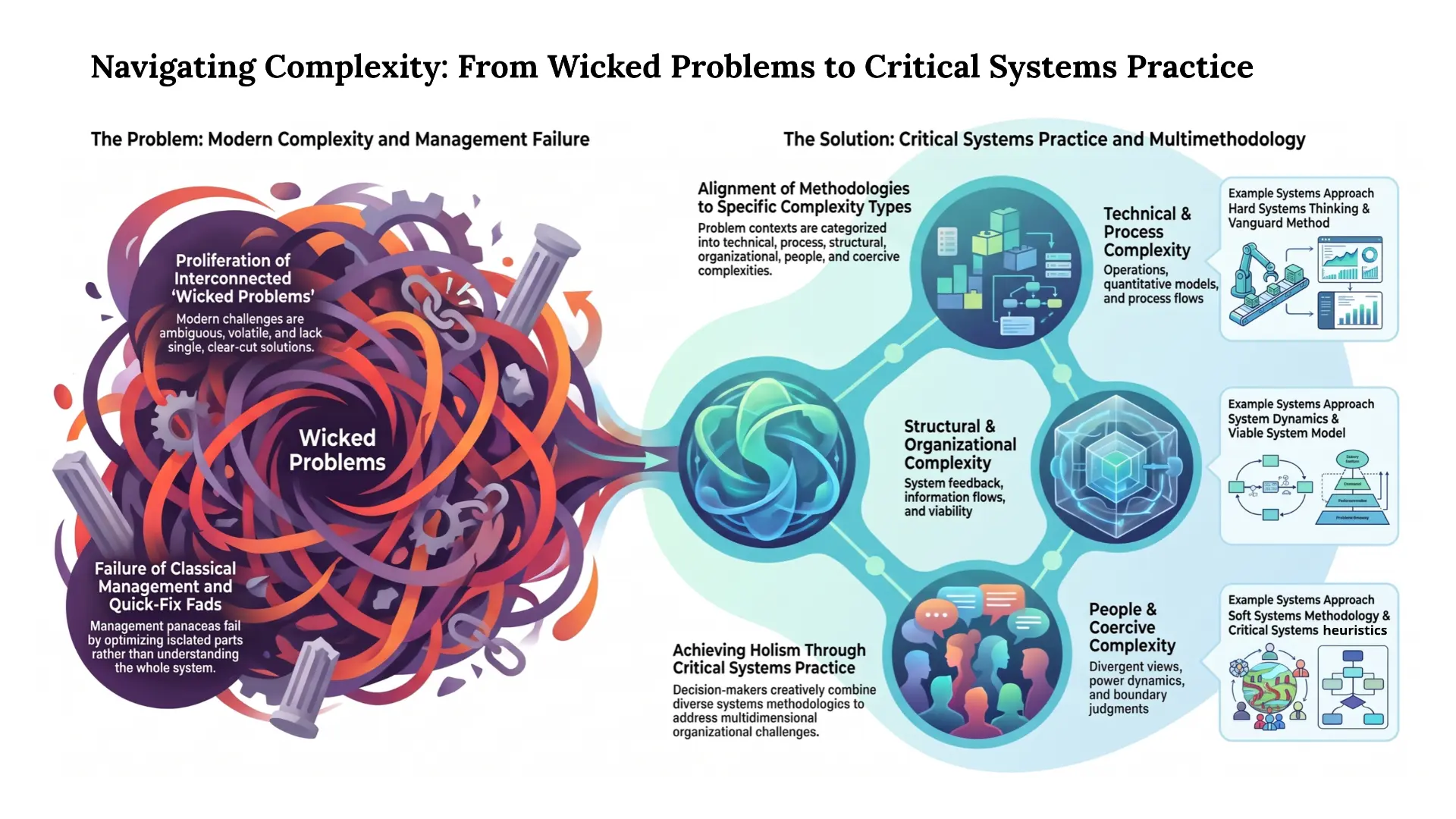
Applying Critical Systems Thinking
Complex projects are “messes”: technical, organisational, human, political and environmental issues all interact, and no single method can see the whole. Critical systems thinking accepts this. It doesn’t look for one right answer. It looks at the situation through several lenses, picks the methods that suit the issues that matter most, and keeps learning as the situation changes. As Michael Jackson outlines in his book “Critical Systems Thinking: A Practitioner’s Guide”, critical systems practice, which we apply within our coaching program, puts this into four repeating stages: