
The Cynefin Framework
Effective leadership in complex project environments is not one-size-fits-all. The Cynefin framework helps leaders diagnose their context and respond appropriately.
Sources of Project Complexity
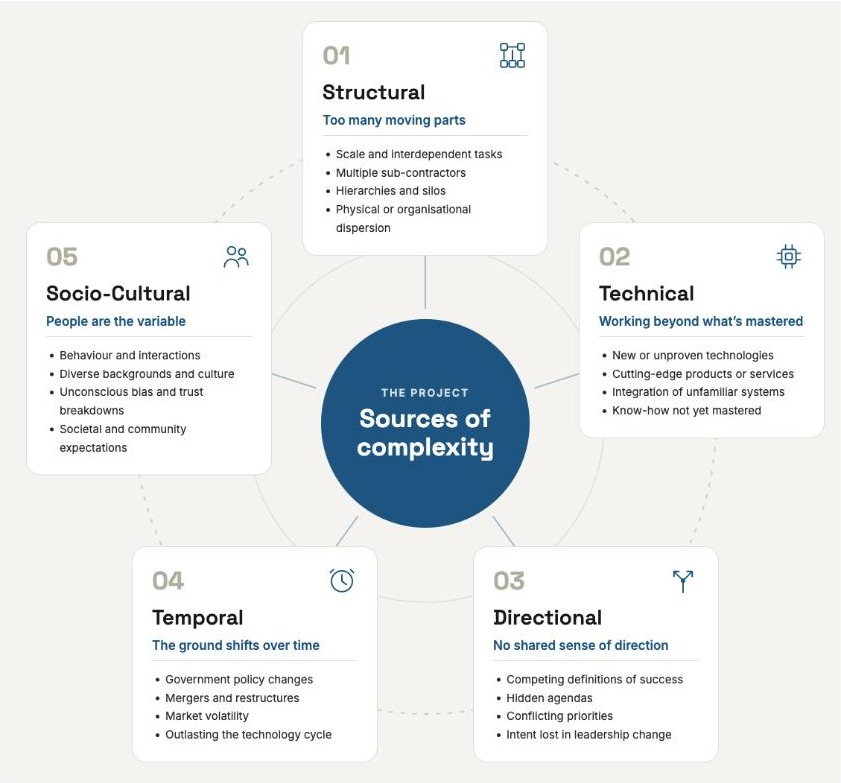
The commonly utilised five sources of complexity (structural, technical, directional, temporal and socio-cultural) proposed by the International Centre for Complex Project Management (ICCPM) give leaders a useful common vocabulary.
They name where difficulty originates, help teams recognise that not every problem is technical, and bring the human dimension of projects into view through the socio-cultural lens.
As a categorisation, they are clear, memorable and easy to apply. However, that very simplicity is also its limitation. This approach allows us to identify what type of complexity is present, but not how to respond. Labelling a project “temporally complex” or “directionally complex” offers description without direction. The categories are static, while the conditions they describe constantly shift and interact.
The ‘Cynefin’ Approach
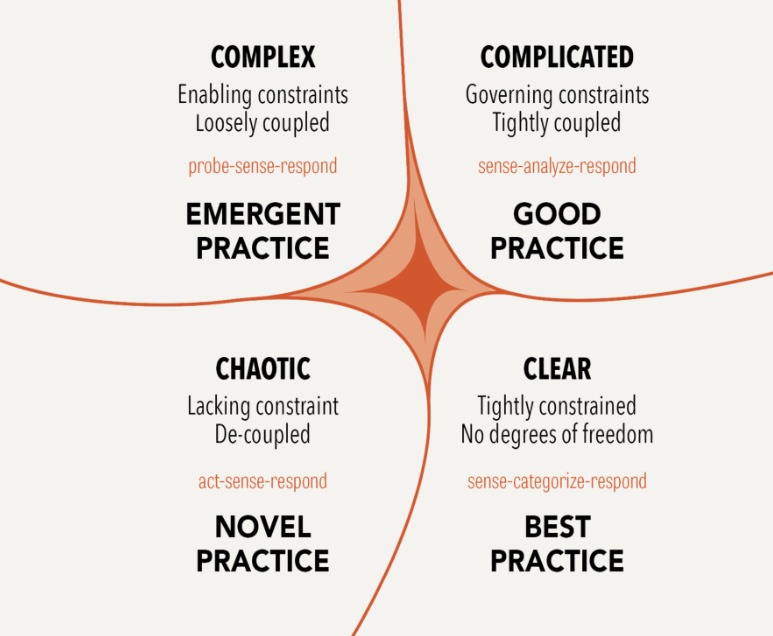
Strategic value emerges when the five sources are combined with analytical sense-making approaches, particularly Cynefin.
Cynefin shifts the question from “what type of complexity is this?” to “what kind of system are we in, and how should we act?” Viewed through this lens, project constraints become the decisive variable.
Together, the frameworks reveal the dynamic interplay between sources and constraints, turning diagnosis into the basis for strategic decision-making.