
Sensemaking
Complex projects rarely unfold as planned. Sensemaking is the capability that helps leaders and teams interpret what’s really happening, test alternatives, and act with confidence. When the plan no longer fits the situation, sensemaking turns ambiguity into informed, adaptive action that delivers outcomes.
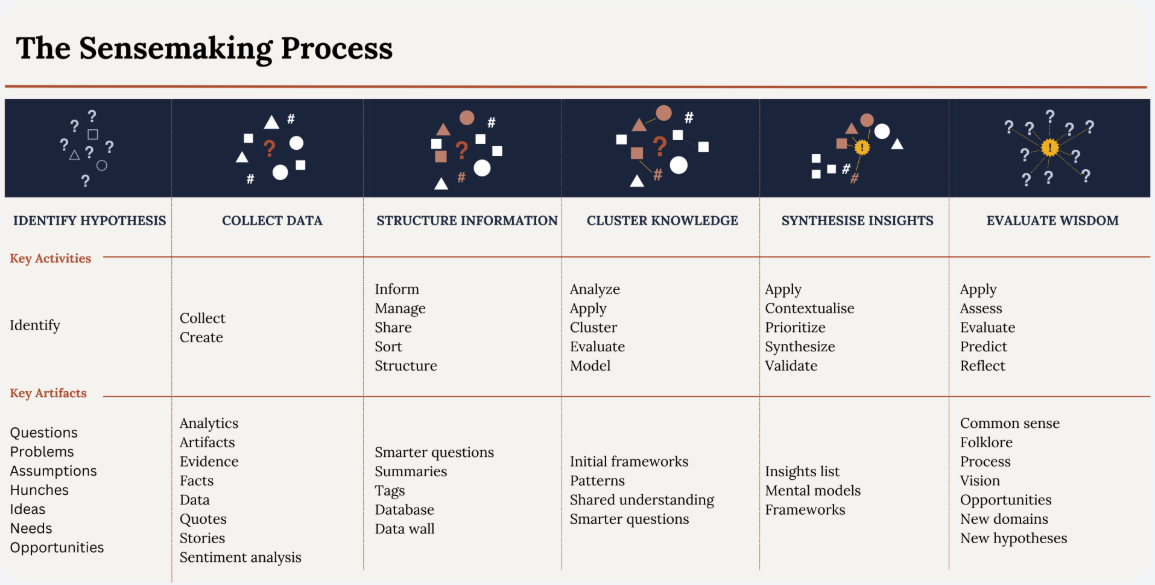
How is it applied?
Sensemaking is how people and teams interpret ambiguous, unexpected or confusing situations well enough to act.
Research by Turner and colleagues (2023) synthesises decades of work from Weick, Dervin, Klein, Snowden and Russell into a multifaceted model.
It describes sensemaking as moving between reason and action. Teams first sense their environment, build shared meaning, and shape how others understand the situation. They then test alternatives by asking “what if?” and “what could have happened instead?” These counterfactuals form the bridge from understanding to action.
Finally, teams look forward, move decisively, and evaluate their impact.
For project leaders, this has practical consequences through identification of early signals. This allows project leaders to treat emerging conditions and situations as data rather than noise, build shared understanding, use conversation, narrative and metaphor so the whole team sees the same picture.
Importantly, it provides the conditions to be able to test before committing, explore plausible alternatives before locking in a response. It’s all about making small, deliberate moves and adjusting as outcomes emerge. In complex environments, certainty is rare. Teams that make sense well adapt faster, decide better, and deliver outcomes that matter.
“The power is in the interpretation. The whole point of collecting micro-narratives, rather than running surveys or commissioning interviews, is to get closer to how people actually make sense of their situation, in their own terms, before an expert or an institution decides what it means.”
Why We Use SenseMaker Software
SenseMaker® is a distributed digital ethnography tool for gathering and making sense of lived experience at scale. What sets it apart is that participants interpret their own experiences instead of leaving that to outside analysts. Participants use an app on a computer, tablet or phone. They answer a few questions and record a short story about what they see happening. Then they place that experience on a simple graphical interface to show what it means to them, and the responses go anonymously to a dashboard. The result is a blend of qualitative and quantitative data, or in Cynefin’s words, “the scale of numbers with the explanatory power of narrative.” thecynefin.co
The dashboard shows where each response sits and a heatmap of how responses are spread. That lets organisers and stakeholders see the detail, context, patterns, outliers and differences that averaging would normally hide. Organisations use it to guide strategy, inform policy, crowdsource ideas, scale customer and citizen engagement, monitor culture and change, scan the horizon, manage risk and support agile team learning. Settings include employee engagement, healthcare, education and international development. The main appeal is earlier, more nuanced insight into customer, employee and market signals than traditional surveys or interviews give.
Explore a 90 Day SenseMaker engagement on your own complex project
Book a call